
Toms River Elite Roofing specializes in roof leak repair in Toms River, NJ, serving surrounding cities including Leisure Village East, Leisure Village, Silver Ridge, Holiday City South and Beachwood. In more than 20 years of chasing leaks across Ocean County, we have found that the stain on a ceiling is almost never directly beneath the opening that caused it.
That is why every leak call includes a look in the attic as well as on the roof. We follow the water back along the deck, rafters and insulation until we find where it actually gets in, and only then do we price the fix. A repair placed in the wrong spot is a repair you pay for twice.
Once the source is found, we fix it so it stays fixed. That means replacing failed flashing and boots rather than smearing sealant over them, and checking whether the water has damaged decking or insulation that also needs attention.
Where Roof Leaks Start
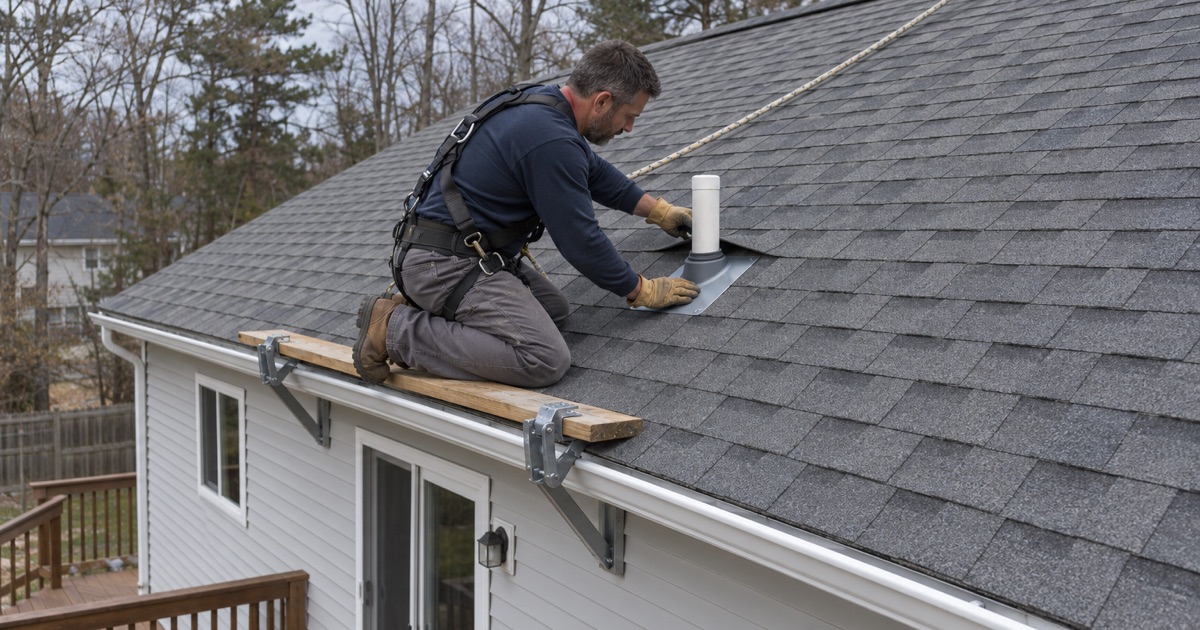
Pipe Boots and Roof Vents
Plumbing vent pipes pass through the roof inside rubber or lead boots, and the rubber collars crack after years of sun. Once the collar splits, water runs down the pipe into the attic and often shows up on a ceiling some distance away. It is one of the most common leaks we see on Toms River houses built in the 1960s and 1970s.
We replace cracked boots with new rubber or lead flashing boots sized to the pipe and integrated into the shingle courses. Plastic roof vents and exhaust caps get the same check, since a cracked housing or loose fastener can let wind-driven rain inside.
Chimneys
Chimneys leak in several ways: through cracked crowns and caps, through open mortar joints, through failed counter flashing and through step flashing that was reused during an earlier re-roof. Water entering at any of those points can travel down inside the chimney chase and appear well below the roofline.
We test the chimney in sections to isolate the cause, then repair the crown, cap, mortar or flashing that is actually failing. Behind a chimney wider than 30 inches, building codes call for a cricket, and when one is missing and water is pooling behind the chimney, we build one.
Skylights
Skylights leak at the curb flashing, at the seal between the glass and frame or through condensation that forms on the glass in cold weather. Each cause needs a different fix, so we look at where the water appears and whether it is clear or carrying dirt from the roof.
Deck-mounted and curb-mounted skylights flash differently, and many older units were installed with homemade flashing. When the flashing is the problem, we reflash with a proper kit. When the unit itself has failed, we explain the replacement options.
Valleys and Wall Junctions
Valleys carry the water from two roof planes, and a worn or poorly lined valley overflows during heavy rain. Where a roof meets a sidewall or dormer, step flashing and kick-out flashing must shed water past the joint. Missing kick-out flashing at a roof edge is a frequent cause of rot hidden behind siding.
We rebuild failed valleys with an ice and water barrier underneath and install new step and kick-out flashing at wall junctions, so water is turned away from the joint rather than driven into it.
Finding the Leak
Tracing From the Attic
In the attic, water leaves a trail: stained sheathing, darkened rafters, rusty nail tips and wet or compressed insulation. We follow that trail uphill from the ceiling stain to the highest point of wetness, which is usually close to where water enters. A moisture meter helps confirm what the eye suggests.
On finished attics and cathedral ceilings, the trail is hidden behind drywall. There we rely more on the roof surface, the pattern of the stain and careful water testing, and we tell you if opening a small section of ceiling would give a more certain answer.
Water Testing
When a leak will not reveal itself, we water-test the roof in sections, starting at the lowest suspect area and working upward while someone watches from inside. Testing one area at a time avoids confusing results, since water applied too high can run down and appear to come from somewhere else.
Some leaks only show up under wind-driven rain from one direction, which a hose cannot always reproduce. In those cases we combine the test with what the attic shows, and we tell you honestly how confident we are in the diagnosis.
When It Is Not a Roof Leak
Not every wet ceiling is a roof problem. Condensation in a poorly ventilated attic, frost melting off nail tips on a winter morning, bathroom fans that exhaust into the attic and sweating pipes all mimic roof leaks. So can a plumbing leak in a bathroom above.
We check for those causes before recommending roof work. If the problem is ventilation or a fan duct, fixing that is cheaper than a roof repair and actually solves the issue.
Fixing the Leak So It Stays Fixed
Replacing Flashing Instead of Caulking It
Sealant has a place, but it cannot replace flashing. A bead of caulk over a failed joint dries, cracks and lets go, usually within a season or two. We remove the failed metal and install new step, counter, apron or boot flashing, lapped correctly so gravity carries water out rather than in.
Repairing Water Damage Below the Roof
A long-running leak can rot decking, stain rafters and soak insulation. We check the deck around the leak for softness and replace damaged sheets before closing the roof. Wet insulation loses its value and can hold moisture against the wood, so we point out where it should be replaced.
If water has reached drywall, we document the interior damage with photos, which helps if you file a claim. Interior repairs are best done once the roof is watertight and the area has dried.
Emergency Tarping
When a leak is active and the weather is not cooperating, the first job is stopping the water. We install tarps secured to resist wind lifting them, and we photograph the damage before covering it so there is a record for your claim. The permanent repair follows once the roof is dry.
Storm and Seasonal Leaks
Wind-Driven Rain in Nor’easters
Nor’easters push rain sideways for hours, forcing water under shingles and into flashing joints that stay dry in ordinary rain. Leaks that appear only in these storms often trace to edges, ridges and the windward side of chimneys and dormers, and we look there first when that is the pattern.
Ice Dams Along the Eaves
In cold weather, heat escaping into the attic melts snow on the upper roof, and the water refreezes at the cold eaves. The ice holds back more melt, which backs up under the shingles. The lasting fix combines an ice and water barrier at the eaves with better attic insulation and ventilation to keep the deck cold.
Leaks at Gutters and Fascia
Water dripping behind a gutter rots fascia and stains soffits, and it is often mistaken for a roof leak. The cause is usually a missing drip edge or a gutter hung too low. We install drip edge, reset or replace the gutter and repair any rotted wood behind it.
- 20+ Years on Shore Roofs
- Line-Item Written Scopes
- Attic and Roof Leak Tracing