
Toms River Elite Roofing provides flat roof repair in Toms River, NJ, serving surrounding cities including Leisure Village East, Leisure Village, Silver Ridge, Holiday City South and Beachwood. Over more than 20 years, we have fixed low-slope roofs on porches, additions, garages, dormers and manufactured homes, and on many houses those small flat sections leak more often than the shingled roof around them.
Flat roofs fail differently from sloped ones. Water moves slowly, so every open seam, blister and flashing gap gets more time to let it in. The repair has to match the membrane already on the roof, and it has to address why water is reaching that spot in the first place.
As with every leak call, we look inside as well as on top. Under a flat roof, water can travel along joists before it appears on a ceiling, and wet insulation can hide much more damage than the stain suggests.
Common Flat Roof Problems on Homes
Split and Lifted Seams
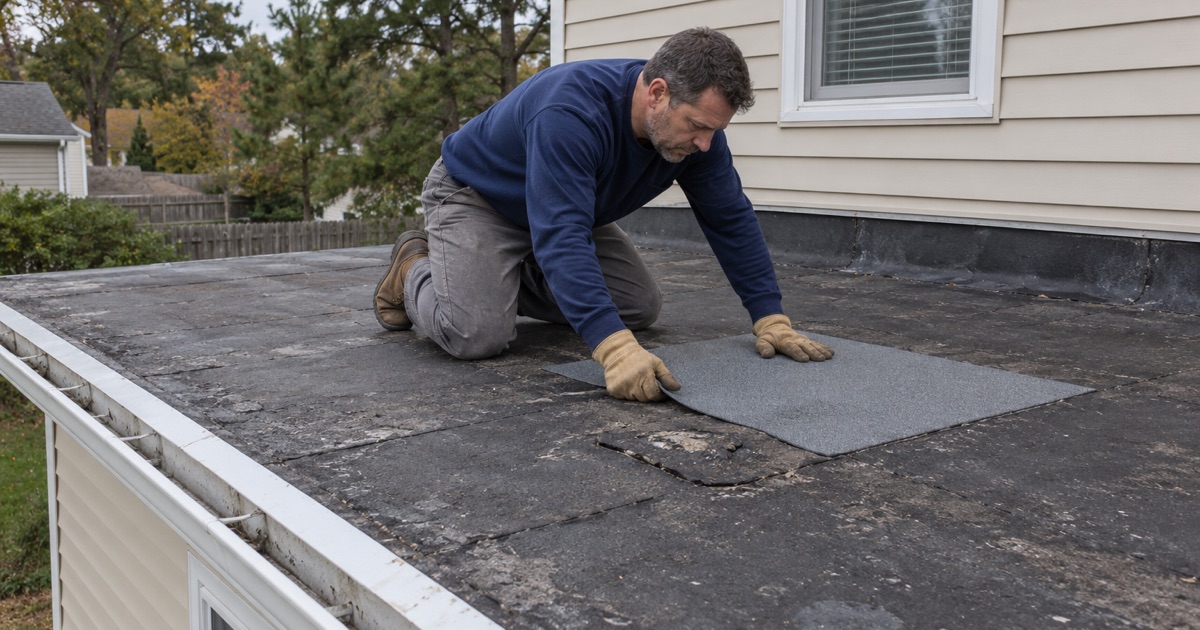
Seams are where flat roofs most often fail. On EPDM rubber roofs, seam tape and adhesive weaken with age and let the laps lift. On modified bitumen, overlaps can separate where the original torching or adhesion was uneven. On TPO, poorly welded seams can open as the roof expands and contracts.
We clean and prepare the seam, then repair it with materials compatible with the membrane, such as new seam tape and cover strips on EPDM, heat welding on TPO or torch-applied or self-adhered patches on modified bitumen. A patch of the wrong material may stick for a season and then peel.
Blisters, Cracks and Surface Wear
Blisters form when moisture or air trapped between layers expands in the sun. Small blisters that are not cracked can often be left and watched. Blisters that have split open, or cracks in an aging surface, let water into the layers below and need repair.
Surface granules on modified bitumen protect it from sun damage. Where they have worn away, the exposed asphalt dries and cracks faster. We repair cracked areas and discuss whether a compatible coating will extend the life of the surrounding roof.
Flashing at Walls and Doors
Many residential flat roofs sit against a wall of the house, such as a porch roof under second-floor windows or a flat addition roof meeting the main house. The flashing at that wall has to run up behind the siding and be counterflashed, and it is often where leaks begin.
We open the siding where needed, run the membrane up the wall to the proper height and install counter flashing so water is carried out and away. Caulking along the top of a flat roof flashing rarely holds for long.
Drainage and Ponding
Drains, Scuppers and Gutters
Water has to leave a flat roof through a drain, a scupper in a parapet or an edge into a gutter. Leaves, pine needles and roofing granules clog those outlets, and water backs up across the roof. We clear the outlets, check that water reaches them and make sure gutters below are sized for the volume.
Correcting Low Spots
Ponding that keeps returning usually means the roof surface has low spots. A sagging deck may need structural repair from below. In other cases, tapered insulation or crickets can be added to direct water toward the outlets. We explain the options and price them separately from the leak repair.
On porch roofs, ponding is often caused by a slope that was never quite enough. Adjusting the slope during a repair is sometimes possible and prevents the same leak from coming back.
Flat Roofs on Manufactured Homes
Seams, Fasteners and Coatings
Toms River counts about 1,361 mobile homes, and many have low-slope metal or membrane roofs. Those roofs typically leak at seams, fasteners and around vents and skylights. We reseal seams, replace failed fasteners and flashing and apply coatings designed for the specific roof material.
Coatings on manufactured home roofs can help when the roof is structurally sound. Applied over a roof with loose seams or rust that has not been treated, they trap problems underneath, so preparation is most of the job.
Roof-Over Systems
When a manufactured home roof has reached the end of its life, a roof-over system adds a new framed roof with pitch and insulation over the existing one. It addresses repeated leaks, improves drainage and can lower heating and cooling costs. We explain how a roof-over compares with continued repairs for your home.
Membrane Repairs by Type
Modified Bitumen and Torch-Down
Modified bitumen roofs are repaired with compatible sheet materials, either torch-applied or self-adhered. On houses with wood trim, siding or parapets nearby, we often use self-adhered materials to avoid open flame near combustible surfaces.
EPDM Rubber
EPDM repairs use primers, seam tape and cured or uncured flashing pieces designed for rubber membranes. The membrane must be cleaned thoroughly first, since dirt and oxidation keep the repair from bonding. On old, shrinking EPDM, we check whether the membrane is pulling away at edges and penetrations.
TPO and PVC
TPO and PVC repairs are heat-welded with matching membrane material. An older TPO roof may need its surface cleaned and prepared before it will accept a weld. Where the membrane has become brittle, a larger section replacement may be more reliable than a patch.
Repair or Replace a Flat Roof
When Repairs Make Sense
A membrane that is still flexible, with isolated seam failures, a few split blisters or a single bad flashing, is a strong repair candidate. Fixing those problems properly can add years to the roof at a fraction of the replacement cost.
When Replacement Is the Better Value
When insulation is wet across large areas, the membrane is cracked throughout or the roof is covered in old patches, more repairs usually just move the leak. We show you the evidence, such as wet insulation cores and photos, and give you an honest recommendation. If replacement is the right answer, the estimate lists tear-off, decking, insulation, membrane and flashing as separate lines.
- 20+ Years on Shore Roofs
- Line-Item Written Scopes
- Attic and Roof Leak Tracing