Toms River Elite Roofing installs metal roofing in Toms River, NJ, serving surrounding cities including Leisure Village East, Leisure Village, Silver Ridge, Holiday City South and Beachwood. In more than 20 years on Ocean County roofs, we have seen metal outperform shingles on the right house and disappoint on the wrong one, so we start with whether metal suits your roof before talking panels.
Metal roofs are long-lived, shed snow easily and resist wind well when installed with the right clips and trim. They also cost more than shingles and depend heavily on installation details that a crew either knows or does not.
Near Barnegat Bay and the ocean, a metal roof also has to suit the salt air. Panel metal, coatings, fasteners and warranty terms all change with distance from the water, and we check each before recommending a product.
Standing Seam Metal Roofs
How Standing Seam Works
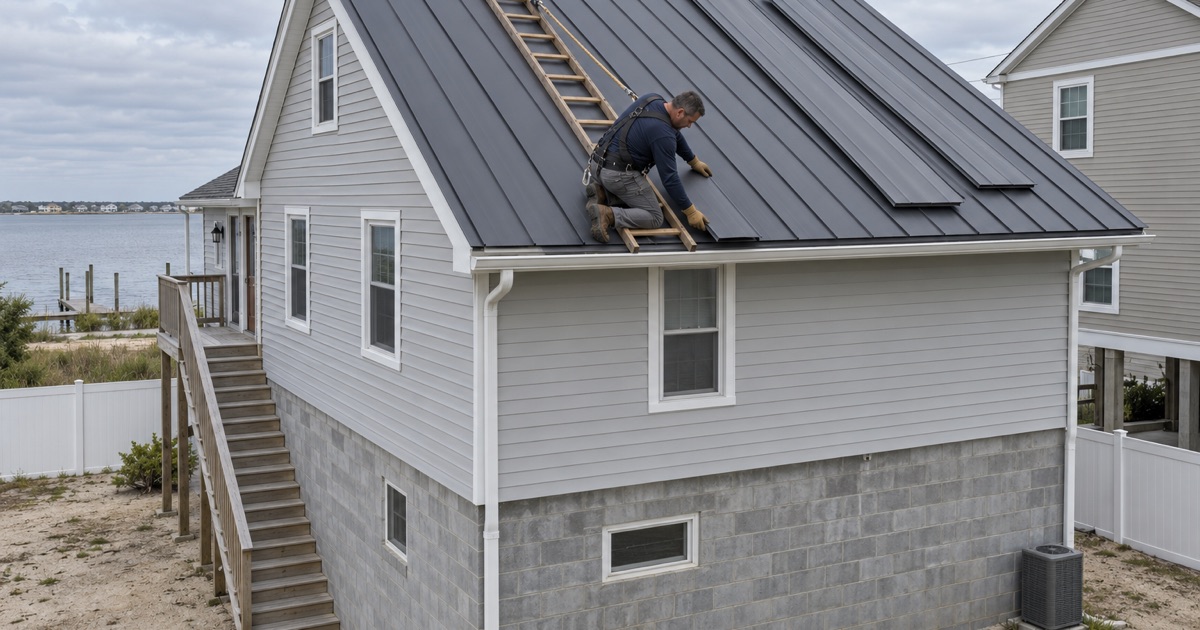
Standing seam panels run from eave to ridge with raised seams joining them. The panels attach with concealed clips under the seams, so no fasteners pierce the weather surface. That leaves far fewer places for water to enter than exposed-fastener metal, whose screws and washers loosen as the metal expands and contracts.
The clips allow each panel to move with temperature changes. That movement is what lets a standing seam roof stay tight through decades of hot summers and cold winters, and it is also why clip spacing and panel length matter so much during installation.
Snap-Lock and Mechanically Seamed Panels
Snap-lock panels click together and suit most residential pitches. Mechanically seamed panels are folded together with a seaming tool, creating a tighter joint suited to lower slopes and higher wind exposure. We recommend a profile based on your roof’s pitch, wind exposure and the look you want.
Panel width and rib height also change the look. Narrower panels with slim seams read as more traditional on a Cape or colonial, while wider flat pans suit modern additions and low porches. We bring samples of both so you can see them against your house rather than choosing from a catalog photo.
Metal for Porches, Additions and Accents
Low-Slope Porch Roofs
Many porches and additions have pitches too shallow for shingles under manufacturer rules. Standing seam metal handles those slopes well and gives a clean, finished look against a shingled main roof. It is one of the most common ways homeowners use metal without committing to a full metal roof.
Where a porch roof meets the house wall, the flashing detail decides whether the porch stays dry. We install metal flashing integrated with the siding and the panel trim, so water is carried away from the joint.
Bay Windows and Dormers
Small metal roofs over bay windows and dormers add contrast and protect areas where shingles are awkward to install. We fabricate these sections to fit, with trim that matches the panel color and edges that drain into the gutter system.
These accents work best when the color is chosen alongside the main roof. A dark bronze or charcoal metal over a bay window can tie together dark shingles and window trim, while a contrasting color calls attention to the feature. Either way, the flashing at the wall is built the same careful way as on a full roof.
Metal Roofing Near Salt Water
Steel, Aluminum and Coatings
Most residential metal panels are steel with a zinc or aluminum-zinc metallic coating and a paint finish on top. Aluminum panels do not rust in the same way and are often specified near salt water, though they cost more and behave differently under expansion. The right choice depends on how close the house is to the water and what the warranty covers.
Paint systems vary too. Higher-grade finishes hold color and resist chalking longer, which matters on a roof facing the full sun of a south or west exposure. We show you finish options with their warranty terms side by side, since the paint warranty and the panel warranty are often separate documents.
Warranty Distance Limits
Some metal panel warranties exclude installations within set distances of breaking surf, large bays or marshes, or require a different coating or metal inside those zones. These limits differ between manufacturers. Before recommending a panel, we read the actual warranty terms and compare them with your property’s location, so you do not learn about an exclusion after a claim.
We also discuss upkeep. Some manufacturers recommend rinsing panels with fresh water in salt-exposed areas, and following that guidance can matter for coverage.
Fasteners and Trim
The clips, screws and trim fasteners on a metal roof must be compatible with the panel metal and resistant to salt. Mixing incompatible metals invites corrosion where they touch. We use fasteners and flashing metals chosen for the panel and the exposure, not whatever is on the truck.
Comparing Metal and Shingles
Cost and Lifespan
A metal roof costs more to install than an architectural shingle roof, and its value comes from its long life and low maintenance. For homeowners planning to stay many years, that trade can make sense. For a house likely to be sold soon, a quality shingle roof is often the better investment, and we say so.
When you ask for both options, we price them on the same itemized format, with tear-off, decking, underlayment, flashing and ventilation listed separately. Seeing the two roofs line by line makes it clear where the extra cost of metal goes and what you receive for it.
Wind, Snow and Fire
Properly installed standing seam roofs perform well in high winds, shed snow quickly and carry Class A fire ratings in many assemblies. Snow sliding off a metal roof can be heavy, so we discuss snow guards above entries, walkways and lower roofs.
Wind performance depends on the clip spacing, panel gauge and edge trim, not just the panel name. Eaves, rakes and ridges see the strongest uplift in a storm, so we follow the manufacturer’s high-wind attachment details at those edges and use cleats that lock the panel ends in place.
Planning a Metal Roof Installation
Tear-Off and Underlayment
We remove existing shingles, inspect and repair the deck and install a high-temperature underlayment suited to metal. New Jersey’s re-roofing rule requires tear-off when two or more layers exist, and removing the old roof also lets us correct any decking problems before panels go on.
Ventilation and Solar Readiness
Metal roofs still need balanced attic ventilation, with soffit intake and a vented ridge closure designed for the panel profile. If solar panels are planned, seam-mounted clamps can hold the array without drilling the metal, and we plan seam spacing with that in mind.
- 20+ Years on Shore Roofs
- Line-Item Written Scopes
- Attic and Roof Leak Tracing