Toms River Elite Roofing handles chimney repair in Toms River, NJ, serving surrounding cities including Leisure Village East, Leisure Village, Silver Ridge, Holiday City South and Beachwood. After more than 20 years on Ocean County roofs, we know the chimney is one of the most common places for water to enter a house, and that most of those leaks start where masonry meets roofing.
Our chimney work focuses on that junction and on the parts of the chimney exposed above the roof: the flashing, the cricket behind it, the crown and cap on top and the mortar joints in between. Those are the parts that keep rain out of the attic and walls.
Every chimney leak call includes a look from the attic as well as from the roof. Water entering at a chimney can travel along framing before it appears inside, so we trace it back to the source before deciding what to repair.
Chimney Flashing
Step Flashing Along the Sides
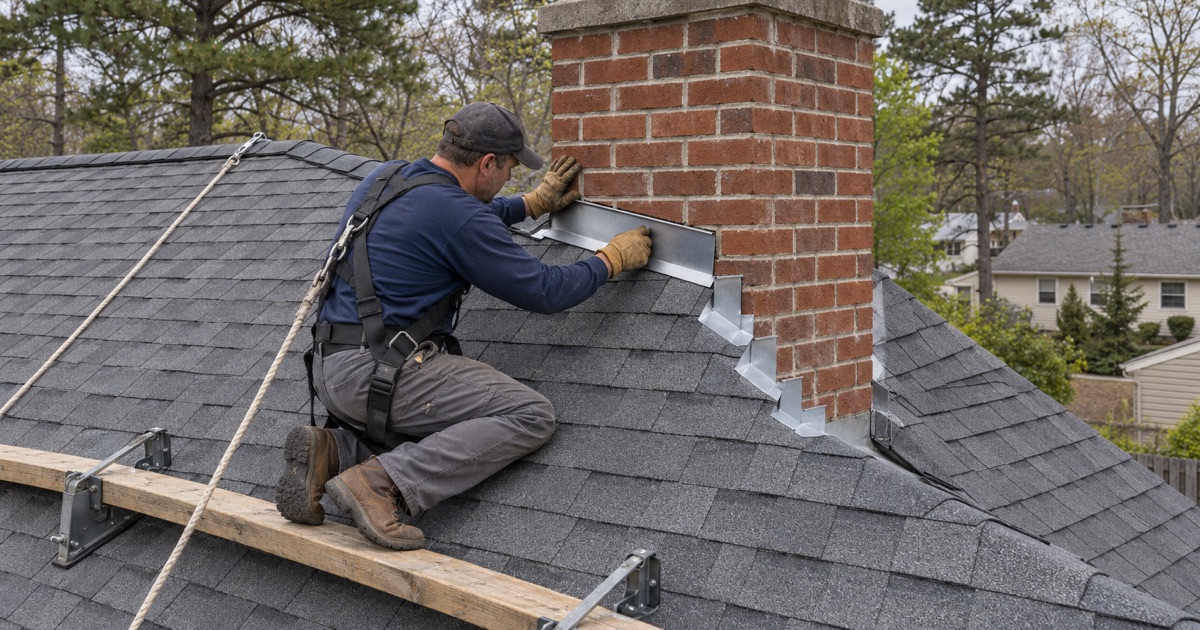
Step flashing consists of individual L-shaped pieces woven into each course of shingles along the sides of the chimney. Each piece sheds water onto the shingle below it. When the pieces are missing, too short or rusted through, water runs straight down the side of the chimney into the roof deck.
On older roofs we often find step flashing that was reused from an earlier job, bent back into place and caulked. That might hold for a while, but it rarely lasts. We replace the step flashing with new metal, woven into the shingles as the manufacturer intends.
Counter Flashing and Reglets
Counter flashing covers the top edge of the step flashing and is set into the chimney itself. The best installations cut a reglet, a groove in the mortar joint, and tuck the counter flashing into it before sealing. Flashing simply caulked to the face of the brick tends to pull away as the sealant ages.
We cut proper reglets and install counter flashing in stepped sections that follow the roof slope. The result is a joint that relies on overlapping metal rather than on caulk to keep water out.
Apron and Back Flashing
The front of the chimney, facing downhill, gets an apron flashing that laps over the shingles below. The back, facing uphill, collects the most water and debris, and its flashing has to carry that water around the chimney without letting it pool. Both get replaced as part of a full chimney reflash.
Chimney Crickets
What a Cricket Does
A cricket, also called a saddle, is a small ridge built behind the chimney that splits the flow of water and sends it around both sides. Without one, water, leaves and pine needles collect behind a wide chimney, and in winter, snow and ice build up there as well.
The International Residential Code, at R1003.20, calls for a cricket behind chimneys wider than 30 inches measured across the slope. Many older houses were built without one, and the back of the chimney becomes a recurring leak point.
Building a Cricket on an Existing Roof
We frame the cricket with lumber and sheathing, cover it with ice and water barrier and finish it with shingles or metal to match the roof. On a roof replacement, adding a cricket is straightforward because the area is already open. On an existing roof, we open only the area behind the chimney and tie the new work into the surrounding shingles.
Crowns, Caps and Masonry
Chimney Crowns
The crown is the concrete or mortar slab that covers the top of the chimney around the flue. A good crown slopes away from the flue and overhangs the brick so water drips clear of the walls. Many crowns are thin mortar washes that crack within a few years, letting water soak into the brick from the top.
Small cracks can be sealed with a crown repair product. Badly cracked or crumbling crowns are better rebuilt, with a proper slope and drip edge, so water is directed away from the chimney rather than into it.
Chimney Caps
A cap covers the flue opening and keeps out rain, animals and debris. Without one, rain falls directly into the flue and can damage the liner and the masonry inside. Near the coast, we recommend caps made of corrosion-resistant metal, since salt air shortens the life of standard galvanized caps.
Repointing Mortar Joints
Mortar joints wear faster than brick. Once they erode, water soaks into the chimney during every storm and can show up as stains in the attic or on interior walls. Repointing means grinding out the failing mortar to a set depth and packing in new mortar compatible with the existing brick.
Where bricks themselves have spalled or cracked, we replace them. Extensive masonry damage on a tall chimney may need a mason, and we tell you if the job goes beyond what a roofing crew should take on.
Chimneys and Roof Replacement
New Flashing With Every Roof
On every roof replacement, step, counter and chimney flashing is replaced rather than reused. It is one of the clearest differences between estimates, and on our written scope it appears as its own line, so you can see that it is included.
Unused Chimneys
Some Toms River homes have chimneys that no longer serve any appliance. Taking an unused chimney down below the roofline and roofing over the opening removes a recurring maintenance point. We discuss that option when a chimney needs extensive work and is no longer in use.
When to Call a Chimney Specialist
Our work covers the chimney’s exterior above the roof and its connection to the roof. Flue liners, smoke chambers and fireplace inspections belong to chimney sweeps and specialists. If we see signs of interior trouble, such as damaged flue tiles or heavy staining, we recommend having the inside inspected.
- 20+ Years on Shore Roofs
- Line-Item Written Scopes
- Attic and Roof Leak Tracing